Why watch messages between other stations?
A directed ON4KST message shows who is talking to whom. It does not include an antenna direction. During a contest, however, a station requesting, answering or preparing a sked will often point at least approximately towards the station being addressed.
That creates a brief opportunity for stations near the same direction. KST4Contest has recognised this situation since version 1.1. The detection and user-list highlight work independently of the local DX Cluster server.
How is the opportunity derived?
Assume that station A sends a directed message to station B. KST4Contest:
- calculates the direction from A to B and treats it as the likely antenna direction of A;
- calculates the direction from A to the local station;
- compares the angular difference with half of the configured antenna beamwidth; and
- checks that A is inside the configured maximum QRB.
If the local station lies inside this assumed antenna corridor, A becomes a directional opportunity. A reply from B is a new case: the likely direction is then calculated from B back towards A.
The configured beamwidth is the complete angle. With 70°, KST4Contest therefore assumes a corridor of 35° on either side of the direction between the two stations.
What does the operator see?
The sender's callsign appears green and bold in the user list for five minutes. A later matching message restarts this period. If the station sends another directed message which no longer matches the geometry, the mark is removed immediately.
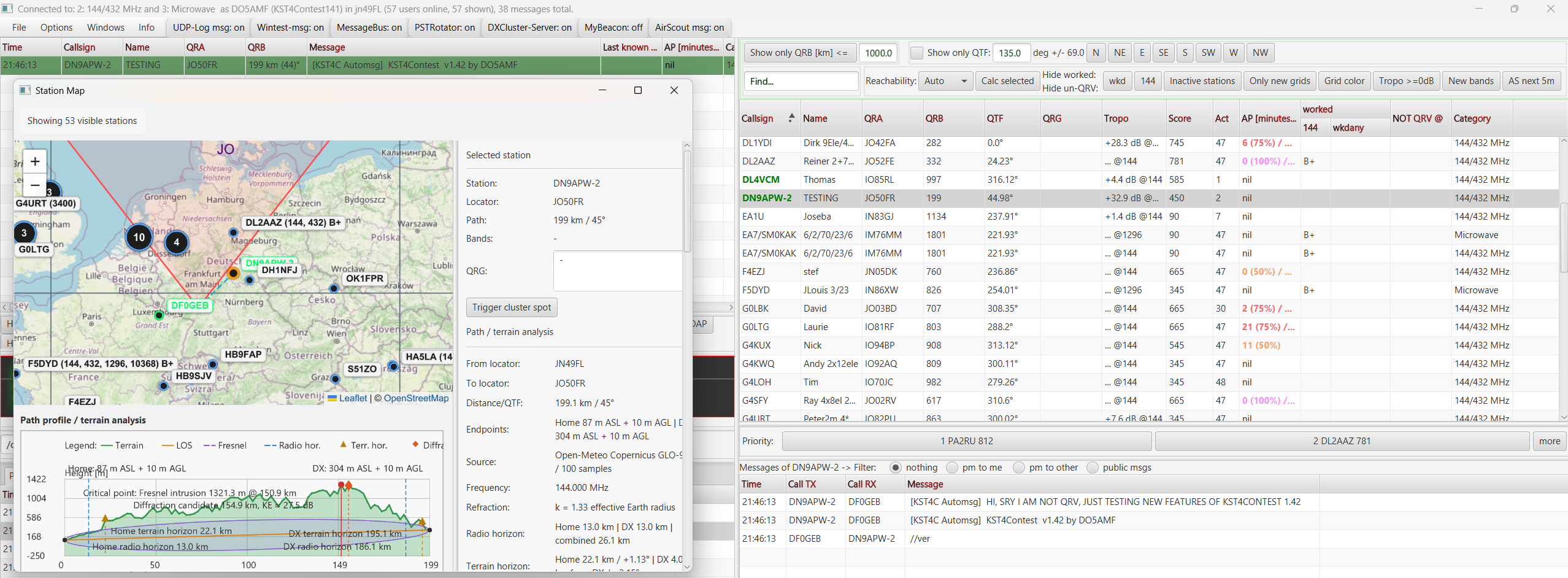
When simple sound notifications are enabled, the first detection also produces a short acoustic indication. Further matching messages do not repeat the sound while the station is already marked.
What practical value does it have?
The indication draws attention to a station at the moment when its antenna may already cover the local direction. It can be enough to notice a callsign which would otherwise remain one line among many in the chat.
DM5M reports that around 35–40% of the directional opportunities used at that station have resulted in a QSO. This is station-specific operating experience, not a general success rate. Location, antenna patterns, propagation, contest activity and operating practice can produce very different results elsewhere.
Optional use in the logger bandmap
Since version 1.23, KST4Contest can forward a detected opportunity and a known QRG through its local DX Cluster server. This is an optional second step. The direction calculation, green user-list mark and sound do not depend on a DX-Cluster connection.
The local DX Cluster output reuses the result; it does not create the directional opportunity. If the server is disabled or no suitable QRG is known, the visual indication still works normally.
What does the indication not prove?
ON4KST does not transmit the actual antenna direction or beamwidth of the remote station. KST4Contest therefore uses the locally configured antenna beamwidth as a practical approximation.
The calculation also does not know the real antenna pattern, rotator position, terrain or current propagation. A matching corridor is not a propagation forecast and does not guarantee a QSO.
In practical terms: the green callsign identifies a geometrically plausible moment to pay attention. Whether calling makes sense remains an operator decision.
Read the complete derivation and numerical examples in the manual.
Open the antenna beamwidth setting.
Read how the optional local DX Cluster output works.